Screen printing is one of the most popular ways to put a design on T-shirts, especially for events, campaigns, teams and businesses. This guide explains screen printing T-shirts from start to finish: how the process works, what affects the cost, how to prepare your artwork, and how to care for the finished garments.
Pely Brand Kenya offers screen printing for customers across Kenya, from our offices and workshop in Nairobi. There is no minimum order, and every job is quoted individually. Request a quote.
Screen printing T-shirts is popular because it gives bold, durable prints, especially on larger orders. Here is how screen printing T-shirts works, step by step.
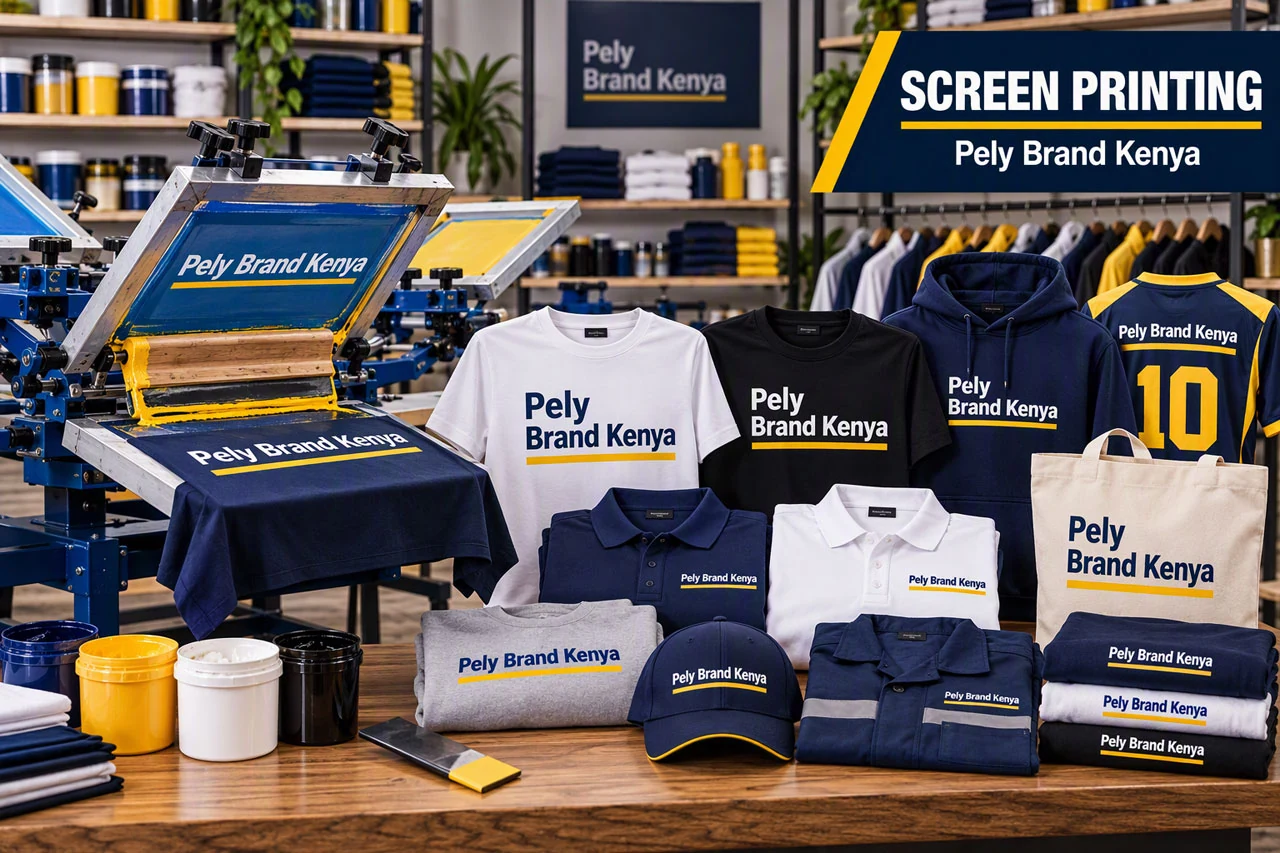
How screen printing works
- Artwork is prepared. The design is separated into colours.
- A screen is made for each colour. The stencil blocks ink everywhere except the design.
- The garment is positioned. It is held flat so the print lands in the right spot.
- Ink is pushed through the screen. A squeegee presses the ink onto the fabric, one colour at a time.
- The print is cured. Heat sets the ink so it lasts through washing.
- The garments are checked and packed.
When screen printing is the right choice
- You need many T-shirts with the same design.
- Your design uses a limited number of solid colours.
- You want a durable, professional print.
- You are ordering for an event, campaign, team or company.
For very small runs, or designs with many colours or photographic detail, heat press printing may be a better fit. Our guide to embroidery vs screen printing vs heat press compares them side by side.
What affects the cost of screen printed T-shirts
| Factor | How it affects the cost |
|---|---|
| Quantity | Set-up is a fixed effort, so the cost per T-shirt usually falls as the quantity rises |
| Number of colours | Each colour needs its own screen and print pass |
| Print size and placement | Larger prints and extra positions, such as front and back, add to the work |
| Garment | The blank T-shirt or garment affects the total |
| Artwork | Clean artwork is quicker to prepare; redrawing a low-quality image takes more time |
| Deadline | Tight deadlines can affect scheduling |
Ask for the garment and the printing quoted as separate lines so you can compare quotes fairly.
How to prepare your artwork
- Send a vector file (AI, EPS, SVG or PDF) if you have one.
- If you only have an image, send the largest, clearest version available.
- Keep the number of colours as low as your design allows.
- Tell us the print size and where it goes on the garment.
- Include the colours of the garments you want printed.
Placement ideas
- Left chest for a small logo
- Centre chest or full front for a larger design
- Back print for a name, slogan or team message
- Sleeve for a small logo or number
Caring for screen printed T-shirts
- Turn the garment inside out before washing.
- Wash in cool or warm water and avoid harsh bleach.
- Avoid ironing directly on the print.
- Follow the care label on the garment.
Common mistakes to avoid
- Sending a low-resolution image.
- Using more colours than the design needs.
- Not confirming the print size and placement.
- Comparing quotes without checking what is included.
- Leaving the order to the last minute.
Is screen printing T-shirts right for your order?
Screen printing T-shirts works best when you have a clear design, a limited number of colours and a reasonable quantity. If you are comparing options, remember that screen printing T-shirts is not the only choice: heat press suits small runs and detailed designs. When you ask for a quote on screen printing T-shirts, send your artwork, quantity, garment colours and deadline so the price is accurate. To learn more about the technique, see this article on screen printing.
Screen printing T-shirts: frequently asked questions
How does screen printing on T-shirts work?
What affects the price of screen printed T-shirts?
Is screen printing cheaper in bulk?
What artwork file is best for screen printing?
Is there a minimum order for screen printing?
How do I care for screen printed T-shirts?
Can you print on garments I supply?
Ready to print? Request a quote or WhatsApp us on +254 725 123278 with your design, quantity and deadline. We reply within 2 hours.